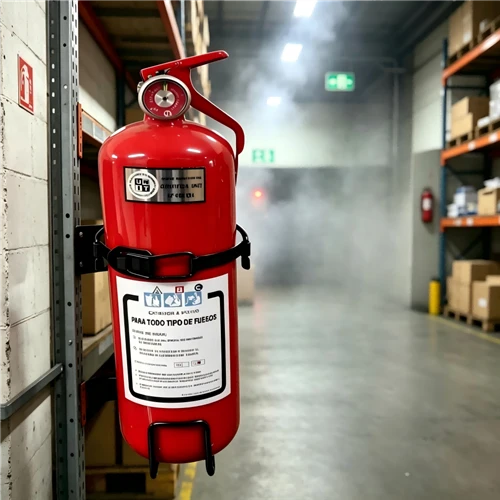
Portable Dry Powder Fire Extinguisher
Operating Method
Simple Operation Steps: Pull, Remove, Hold, Press
- 1. Pull: Lift the fire extinguisher from the storage location.
- 2. Remove: Remove the safety pin.
- 3. Hold: Hold the nozzle and aim it at the base of the flame.
- 4. Press: Press the handle and sweep the powder from side to side across the fire source.
Applicable Fire Classes
Dry powder fire extinguishers are suitable for:
- Class A Fire: Solid combustible material fires (Wood, Paper, Cotton, Textiles).
- Class B Fire: Flammable liquid fires (Gasoline, Diesel, Cooking oil).
- Class C Fire: Flammable gas fires (Natural gas, LPG).
- Class E Fire: Electrical equipment fires.
Key Precautions
- Stand Upwind: Operate from the upwind or side-upwind direction.
- Prevent Re-Ignition: Monitor materials after flames are extinguished.
- Prevent Dust Inhalation: Ensure ventilation and avoid prolonged exposure.
- Consider Cleaning: Avoid using near sensitive precision equipment due to corrosive residue.
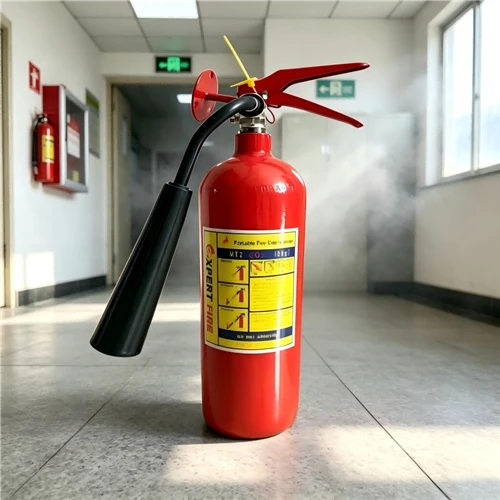
Carbon Dioxide (CO₂) Fire Extinguisher
Operating Method
Simple Operation Steps: Pull, Remove, Hold, Press
- 1. Pull: Lift the extinguisher.
- 2. Remove: Remove the safety pin.
- 3. Hold: Hold the horn handle or insulated grip. Do not touch the metal discharge horn directly to avoid frostbite.
- 4. Press: Press the handle and discharge CO₂ close to the fire source.
Applicable Fire Classes
- Class B Fire: Flammable liquid fires.
- Class C Fire: Flammable gas fires.
- Class E Fire: Electrical equipment fires below 600V.
Recommended Applications
CO₂ extinguishers are especially suitable for valuable equipment, archives, computer equipment, and precision instruments. Because CO₂ leaves no residue after discharge, it helps reduce equipment contamination.
Key Precautions
- Prevent Frostbite: Always hold the insulated handle or the rubber discharge tube. Never touch the metal horn during operation.
- Avoid Use in Confined Spaces: CO₂ can reduce oxygen concentration. Use carefully in enclosed areas and evacuate quickly after discharge.
- Residue-Free Extinguishing: CO₂ leaves no powder or foam residue, making it suitable for clean environments.
Water-Based Fire Extinguisher
Operating Method
Simple Operation Steps: Pull, Remove, Hold, Press
- 1. Pull: Lift the extinguisher.
- 2. Remove: Remove the safety pin.
- 3. Hold: Hold the spray nozzle or discharge gun.
- 4. Press: Spray onto the surface of the burning material to create a cooling layer and reduce oxygen contact.
Applicable Fire Classes
- Class A Fire: Solid combustible material fires (Wood, Paper, Fabric).
- Class B Fire: Flammable liquid fires (Some formulations are specifically designed for these).
- Class F Fire: Cooking oil and fat fires (Kitchen oil fires).
Special Application & Precautions
Some water mist extinguishers are designed for electrical fires below 36kV if certified for insulation. However, do not use on water-reactive chemicals (e.g., Sodium, Potassium) or electrical equipment without power isolation unless specified.
- Prevent Freezing: Store under suitable temperature conditions in cold environments.
- Environmental Benefits: Water-based agents are generally environmentally friendly and effective for cooking oil fires.
Wheeled Dry Powder Fire Extinguisher
Operating Method
Simple Operation Steps: Move, Deploy, Open, Spray
- 1. Move: Two operators should move the extinguisher close to the fire area, usually 8–10 meters away.
- 2. Deploy: Extend the discharge hose. One operator holds and controls the spray nozzle.
- 3. Open: The second operator opens the cylinder valve counterclockwise or activates the discharge mechanism.
- 4. Spray: Aim at the base of the flame and sweep from side to side.
Applicable Fire Classes
- Class A Fire: Solid combustible materials.
- Class B Fire: Flammable liquids.
- Class C Fire: Flammable gases.
- Class E Fire: Electrical equipment fires.
Recommended Applications
Suitable for large-scale fire risks such as chemical plants, warehouses, oil storage areas, and large workshops. The wheeled design provides higher extinguishing capacity for large fire areas.
Key Precautions
- Two-Person Operation Required: One person controls the spray hose while another operates the valve system.
- Secure The Extinguisher: Apply wheel brakes before spraying to prevent movement.
- Maintain Proper Position: Operate from the upwind direction.

Cabinet-Type Heptafluoropropane Fire Suppression System
Operating Method
Step 1: Confirm the fire situation and ensure all personnel have evacuated the protected area.
Step 2: Activate the system through:
- Automatic Activation: Smoke or heat detectors trigger agent discharge.
- Manual Activation: Break cover and press emergency start button outside the area.
- Mechanical Activation: Remove safety pin and operate valve handle in the cylinder room.
Applicable Fire Classes
- Class A: Solid combustible materials.
- Class B: Flammable liquids.
- Class C: Flammable gases.
- Class E: Electrical equipment fires.
Special Applications
Especially suitable for areas where water-based systems might damage equipment, such as data centers, communication rooms, power distribution rooms, archives, and control rooms.
Key Precautions
- Evacuate Personnel: Ensure all people leave before agent release.
- Maintain Sealing: Room must have airtightness to ensure concentration.
- Ventilate After Suppression: Ventilate to remove harmful decomposition products before re-entry.
- Fixed System: This is a fixed installation, not a portable device.
Summary
Different fire extinguishers are designed for different fire risks and environments. Selecting the correct extinguisher depends on:
- Fire classification
- Protected area conditions
- Equipment sensitivity
- Safety requirements
Proper selection, correct operation and regular maintenance are essential for effective fire protection.