Selecting a trolley fire extinguisher for an industrial facility is not simply a matter of choosing the largest available capacity. The right configuration depends on the type of fire risk, extinguishing agent, required capacity, operating pressure, discharge performance, operating environment, mobility requirements, and applicable market standards.
For factories, warehouses, logistics centers, fuel storage areas, workshops, and other industrial facilities, buyers also need to consider whether the extinguisher can be moved efficiently, whether its technical specifications match the project requirements, and whether the supplier can provide the documentation required for bulk procurement.
This guide explains the main factors to evaluate when sourcing trolley fire extinguishers for industrial applications.
Why Industrial Facilities Use Trolley Fire Extinguishers
Trolley fire extinguishers are designed for applications where a portable extinguisher may not provide sufficient extinguishing agent capacity or discharge duration.
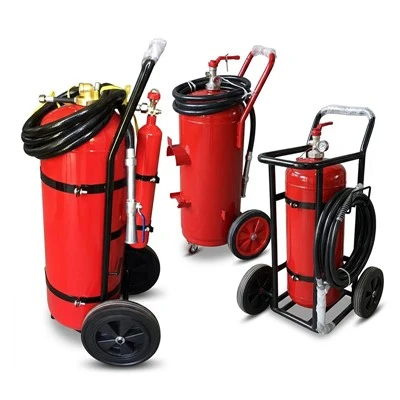
Their wheeled structure allows operators to move a higher-capacity unit without carrying the full weight of the extinguisher. This makes trolley units suitable for larger industrial environments where fire equipment may need to be transported across factory floors, warehouses, workshops, logistics areas, or outdoor facilities.
For industrial buyers, the key advantages are not simply larger capacity. The purchasing decision should consider three factors together:
- Higher agent capacity: Larger units can provide longer discharge duration for appropriate fire risks.
- Mobility: Wheels and a trolley frame make the equipment easier to position during an emergency.
- Industrial configuration: Larger cylinders, hoses, nozzles, and pressure systems can be specified according to the application and market requirements.
Weimin's trolley fire extinguisher range includes 25kg, 50kg, and 50L configurations, with different discharge times and performance specifications depending on the model.
Identify the Fire Risk Before Choosing the Extinguisher
The first step is to identify the materials and processes that create the fire risk.
A manufacturing plant may contain combustible packaging, plastics, textiles, oils, solvents, electrical equipment, or other materials. A warehouse may have a different fire load from a fuel storage area or chemical processing facility.
Before selecting a trolley fire extinguisher, buyers should clarify:
- What combustible materials are present?
- What type of fire hazards need to be addressed?
- Are flammable liquids or fuels stored on site?
- Is electrical equipment located in the protected area?
- Will the extinguisher be installed indoors or outdoors?
- What local fire protection requirements apply?
The extinguishing agent and extinguisher configuration should be selected according to the actual hazard and applicable requirements rather than simply choosing the highest capacity.
Choose the Right Extinguishing Agent
Once the fire risk has been identified, the next step is to determine the appropriate extinguishing agent.
Dry chemical powder is commonly considered for industrial environments where multiple fire classes need to be addressed, subject to the applicable product rating and local requirements. CO₂ extinguishers are used for specific applications where a clean extinguishing agent is required, particularly around certain electrical equipment.
For procurement teams, the important question is not simply "Which agent is better?" but:
Which extinguishing agent is appropriate for the specific fire risk and project standard?
The buyer should confirm the fire rating, extinguishing agent, discharge performance, and applicable certification or testing documentation before placing a bulk order.
Weimin supplies different trolley configurations, including pressurized trolley fire extinguishers and trolley fire extinguishers with external CO₂ systems, allowing buyers to evaluate configurations according to their application requirements.
Select the Appropriate Capacity
Capacity is one of the most important purchasing considerations for a trolley fire extinguisher.
Weimin's trolley models include 25kg, 50kg, and 50L configurations. The appropriate capacity should be determined by the fire risk, required extinguishing performance, equipment weight, storage space, mobility requirements, and applicable project specifications.
A simple purchasing approach is:
25kg: Consider when a high-capacity mobile extinguisher is required but equipment weight and maneuverability remain important.
50kg: Consider for applications requiring a larger extinguishing agent load and longer discharge capability.
50L: Consider according to the specific extinguishing medium, fire rating, and project requirements.
Capacity should not be selected solely according to the size of the building. Industrial buyers should compare the fire risk, equipment configuration, fire rating, discharge performance, and applicable standards as a complete package.
Check Working Pressure, Test Pressure and Discharge Performance
Pressure specifications are particularly important when purchasing wheeled fire extinguishers in bulk.
For example, Weimin's pressurized trolley fire extinguisher is specified with an 18 bar working pressure, while its listed technical parameters include a 27 bar test pressure. The models are available in 25kg, 50kg, and 50L configurations, with discharge times ranging from at least 15 seconds to at least 40 seconds depending on the model.
The trolley stainless steel model page also lists:
- Working pressure: 18 bar
- Test pressure: 27 bar
- Effective range: ≥6m
- Temperature range: -20°C to +60°C
- Capacity: 25kg / 50kg / 50L
The exact performance depends on the selected configuration.
When comparing suppliers, buyers should therefore request more than a single pressure value. The technical comparison should include:
- Working pressure
- Test pressure
- Discharge time
- Effective range
- Fire rating
- Operating temperature
- Cylinder dimensions
- Total equipment weight
This makes supplier quotations easier to compare on a like-for-like basis.
Consider the Cylinder Material and Operating Environment
The operating environment can affect the cylinder and overall equipment requirements.
For example, equipment installed in a general indoor factory may face different environmental conditions from equipment used in coastal warehouses, outdoor fuel storage areas, or industrial facilities with corrosive atmospheres.
Buyers should evaluate:
- Humidity
- Salt exposure
- Chemical exposure
- Outdoor installation
- Temperature fluctuations
- Required surface protection
- Cylinder material
Material selection should always be confirmed against the actual product configuration and applicable standard. Buyers should also request the manufacturer's technical specification rather than relying only on a product title such as "stainless steel" or "industrial grade."
For projects with specific corrosion-resistance or material requirements, the material grade, cylinder construction, surface treatment, and documentation should be confirmed before mass production.
Evaluate Trolley Mobility and Operating Design
A trolley extinguisher is different from a portable extinguisher because its mobility is part of the product's practical value.
Before ordering, industrial buyers should examine:
- Wheel construction
- Frame strength
- Handle design
- Cylinder stability
- Hose length
- Nozzle accessibility
- Overall equipment weight
- Maneuverability on the intended floor surface
For large warehouses or production facilities, the equipment may need to move through aisles, around machinery, or across uneven outdoor surfaces. A high-capacity extinguisher is only useful if personnel can position it effectively when required.
Weimin's trolley designs combine the cylinder, discharge system, hose, nozzle, and wheeled frame into a mobile unit intended for industrial environments.
Verify Certifications, Standards and Product Documentation
Certification requirements vary by destination market and product configuration. Therefore, buyers should not assume that one certification automatically satisfies every market requirement.
Before placing an order, ask the supplier to confirm:
- Applicable product standards
- Certification availability
- Test reports
- Pressure testing documentation
- Product labels and markings
- Technical specification sheets
- Inspection records
- Export documentation
This is particularly important for distributors, fire protection contractors, and project procurement teams that need to submit technical documents for approval before delivery.
The certification and compliance documents should correspond to the actual product model being supplied, rather than simply referring to the manufacturer's general quality management system.
What Should Industrial Buyers Check Before a Bulk Order?
For B2B procurement, product specifications are only one part of the purchasing decision.
Before confirming a bulk order, buyers should create a technical and commercial checklist covering:
Product Requirements
- Extinguishing agent
- Capacity
- Fire rating
- Working pressure
- Test pressure
- Discharge time
- Effective range
- Temperature range
- Cylinder material
Quality Requirements
- Cylinder inspection
- Welding inspection
- Pressure testing
- Leakage inspection
- Valve and hose inspection
- Final assembly inspection
- Product labeling
Commercial Requirements
- MOQ
- Sample availability
- Lead time
- Packaging method
- OEM labeling
- Carton requirements
- Export documentation
This approach reduces the risk of comparing suppliers only by unit price while overlooking differences in specifications, testing, packaging, and documentation.
Why Source Trolley Fire Extinguishers from Weimin?
Shaoxing Weimin Fire Fighting Equipment Co., Ltd. supplies trolley fire extinguishers for industrial and commercial fire protection applications, with product configurations covering 25kg, 50kg, and 50L models. Its product range includes pressurized trolley fire extinguishers, trolley stainless steel configurations, and models with external CO₂ systems.
For distributors, contractors, and industrial buyers, Weimin supports OEM customization, bulk production, product inspection, packaging, and export supply. This allows procurement teams to discuss the required capacity, configuration, destination market, labeling, packaging, and documentation before production.
For a customized quotation, buyers should provide the intended application, required capacity, extinguishing agent, destination market, estimated order quantity, and any certification or packaging requirements.
Trolley Fire Extinguisher Selection Checklist
Before requesting a quotation, confirm these seven points:
- Fire risk: What materials and processes need protection?
- Extinguishing agent: Which agent matches the fire hazard?
- Capacity: Is 25kg, 50kg, or 50L appropriate for the application?
- Performance: What fire rating, discharge time, range, and pressure are required?
- Environment: Will the unit be used indoors, outdoors, in humid areas, or in corrosive environments?
- Compliance: What standards, certifications, and documents are required?
- Procurement: What are the MOQ, packaging, OEM, lead-time, and inspection requirements?
A clear specification checklist allows buyers to obtain comparable quotations and reduces the risk of ordering a configuration that does not meet the project's technical requirements.
FAQ
Q: What size trolley fire extinguisher should I choose?
A: The required capacity depends on the fire risk, extinguishing agent, fire rating, discharge performance, operating environment, and applicable project requirements. Capacity should not be selected solely according to facility size.
Q: What is the difference between a portable and trolley fire extinguisher?
A: A trolley fire extinguisher is designed for higher-capacity applications and uses a wheeled frame to facilitate movement. This makes it suitable for larger industrial areas where a portable unit may provide insufficient agent capacity or discharge duration.
Q: What pressure specifications should I request from a supplier?
A: Ask for the working pressure and test pressure, together with discharge time, effective range, temperature range, and the relevant product testing documentation.
Q: Can trolley fire extinguishers be customized for bulk orders?
A: Customization may include product configuration, labeling, packaging, and other project-specific requirements. The exact options should be confirmed according to the product model and destination market.
Q: What information should I send when requesting a quotation?
A: Provide the intended application, fire risk, required capacity, extinguishing agent, destination market, estimated order quantity, certification requirements, and packaging or OEM requirements. This gives the manufacturer enough information to prepare a more accurate technical and commercial proposal.