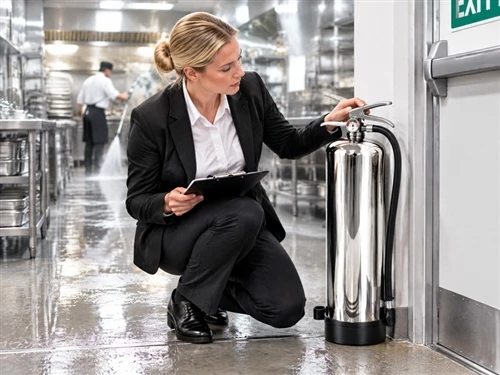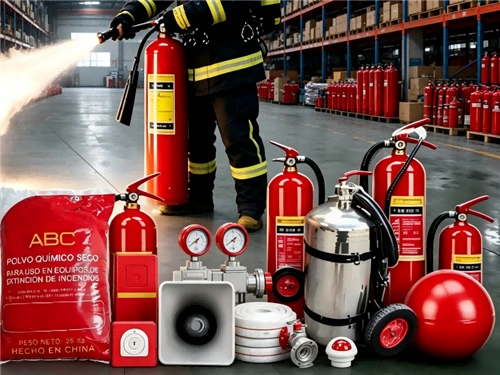
A stainless steel fire extinguisher is considered when the operating environment, corrosion exposure, appearance requirements or long-term equipment condition make cylinder material an important purchasing factor.
Compared with conventional painted carbon-steel extinguishers, stainless steel construction offers a different approach to cylinder protection. SUS304 stainless steel, for example, provides corrosion resistance as an inherent material characteristic rather than relying primarily on an external paint coating.
However, stainless steel should not be selected simply because it sounds more durable. For commercial and industrial buyers, the right choice depends on the fire rating, extinguishing agent, cylinder construction, pressure requirements, operating environment, certification and total procurement cost.
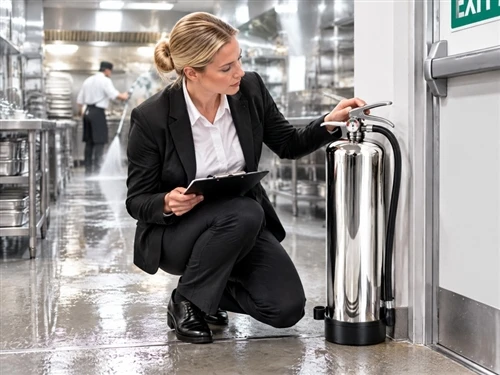
Quick Answer: Why Choose Stainless Steel?
The main reason to choose a stainless steel fire extinguisher is to obtain a cylinder material with higher corrosion resistance and a durable stainless-steel surface, particularly where moisture, humidity, cleaning conditions or appearance are relevant to the application.
The benefits can include:
Better resistance to surface corrosion than conventional painted carbon steel when appropriately specified
No reliance on a conventional exterior paint coating for the stainless-steel surface
Suitability for humid or demanding environments where material selection matters
A clean metallic appearance for visible installations
Reduced concern about paint damage affecting the external appearance
A material option for projects with specific stainless-steel requirements
The material, however, does not automatically determine fire performance. Portable extinguishers still need to meet the applicable construction, performance and testing requirements for their intended market. For example, Singapore's SCDF requires portable extinguishers, where provided, to conform to SS EN 3 and to be charged, tested and maintained according to SS 578.
What Makes a Stainless Steel Fire Extinguisher Different?
The key difference is the cylinder material.
A conventional fire extinguisher commonly uses carbon steel with an external protective coating. Stainless steel extinguishers instead use stainless steel for the cylinder construction, providing corrosion resistance through the material itself.
For buyers, this changes how the product should be evaluated.
A procurement team should not ask only:
"Is the extinguisher stainless steel?"
It should also confirm:
- Stainless steel grade
- Cylinder construction
- Wall and forming requirements
- Welding method
- Valve configuration
- Working and test pressure
- Extinguishing agent
- Fire rating
- Applicable certification
- Operating environment
This distinction is important because stainless steel is a material specification, not a fire-rating specification.
Key Benefits of Stainless Steel Fire Extinguishers
Better Corrosion Resistance
One of the strongest reasons to select stainless steel is its resistance to corrosion.
A painted carbon-steel extinguisher relies heavily on the integrity of its coating to protect the underlying steel. Scratches, impact damage or coating deterioration can expose the metal underneath.
Stainless steel provides corrosion resistance through its alloy composition, making it an attractive option where the external condition of the cylinder is an important consideration.
This does not mean stainless steel is immune to corrosion. Material grade, surface condition, contaminants, environmental exposure and maintenance still matter.
Better Suitability for Humid Environments
Humidity can become a long-term concern for fire protection equipment.
Applications near:
- Coastal areas
- Ports
- Hotels and resorts
- Food-service facilities
- Commercial kitchens
- Industrial facilities
- Warehouses
- Equipment rooms
may require greater attention to cylinder corrosion and surface condition.
For these applications, stainless steel can be considered when its corrosion-resistance characteristics align with the project requirements.
Durable Visible Appearance
Fire extinguishers are often installed in locations where the cylinder remains visible.
A stainless-steel finish provides a clean industrial appearance without relying on a conventional painted exterior.
This can be relevant to:
- Commercial buildings
- Hospitality projects
- High-visibility public areas
- Food-service facilities
- Industrial equipment areas
The appearance benefit is secondary to fire protection performance, but it can still influence purchasing decisions for projects where equipment remains exposed.
Stainless Steel vs. Painted Carbon Steel Fire Extinguishers
For procurement teams, the more useful question is not whether stainless steel is universally "better," but which cylinder material is more appropriate for the application.
| Factor | Stainless Steel | Painted Carbon Steel |
|---|---|---|
| Corrosion Resistance | Inherent material advantage | Relies significantly on protective coating |
| Exterior Finish | Stainless-steel surface | Painted/coated surface |
| Humid Environment | Strong candidate when properly specified | Requires suitable coating protection |
| Appearance | Metallic finish | Color-coated finish |
| Coating Damage | No conventional paint layer to chip | Damaged coating may expose steel |
| Initial Cost | Generally higher | Generally lower |
| Procurement Priority | Material durability and environment | Cost efficiency and general applications |
A buyer should therefore consider environmental exposure and lifecycle requirements, rather than choosing solely according to the initial unit price.
For projects where standard painted steel already meets the technical and environmental requirements, stainless steel may not provide enough additional value to justify the higher material cost.
For more demanding environments, however, the material difference can become much more relevant.
Is SUS304 Stainless Steel Suitable for Fire Extinguishers?
SUS304 is a common stainless-steel grade used when corrosion resistance and general durability are required.
For a SUS304 stainless steel fire extinguisher, the material decision should be evaluated together with the complete cylinder design.
Important procurement questions include:
Is SUS304 specified for the cylinder itself?
Is the material documentation available?
Is the cylinder designed for the required pressure?
Is the welding process controlled?
Are welds inspected?
Does the finished extinguisher meet the applicable product standard?
Is the product certified for the destination market?
SUS304 should not be treated as a substitute for certification or fire testing. Material grade and fire performance are two separate purchasing criteria.
Does Stainless Steel Improve Fire Extinguisher Performance?
Not directly.
This is one of the most important points for buyers to understand.
A stainless steel cylinder can improve the product's resistance to environmental corrosion, but the stainless-steel material itself does not automatically increase the fire rating.
Fire performance depends on the tested extinguisher configuration, including factors such as:
- Extinguishing agent
- Agent quantity
- Discharge characteristics
- Cylinder design
- Operating pressure
- Fire-rating test results
- Applicable product standard
Therefore, buyers should avoid comparing extinguishers simply by material or capacity.
For example:
SUS304 does not mean a higher fire rating.
Likewise:
A heavier extinguisher does not automatically mean better fire performance.
The correct procurement approach is to evaluate the complete tested product specification.
Singapore's SCDF also emphasizes that extinguisher selection should consider the anticipated fire hazards, extinguisher effectiveness for the relevant hazard and the weight that occupants can handle.
Where Are Stainless Steel Fire Extinguishers a Practical Choice?
Stainless steel becomes more attractive when the operating environment makes corrosion resistance an important purchasing criterion.
Typical applications can include:
Coastal and Humid Facilities
Salt-laden air and high humidity can increase corrosion concerns for exposed metal equipment.
Commercial and Hospitality Buildings
Where extinguishers are highly visible, stainless steel can provide a different appearance from conventional painted cylinders.
Food-Service Areas
Stainless-steel equipment is already common in many food-service environments, making stainless-steel fire protection equipment a potential fit where project specifications allow it.
Industrial Facilities
Factories and equipment rooms may have higher exposure to moisture, cleaning chemicals or demanding environmental conditions. The exact suitability should be assessed according to the site conditions.
Export Projects With Specific Material Requirements
Some buyers specify stainless steel because of project standards, customer specifications, environmental conditions or corporate equipment requirements.
The key point is that stainless steel should be selected because the application benefits from the material-not simply because it is a premium-looking alternative.
What Should Buyers Check Before Ordering?
For bulk procurement, material grade alone is not enough.
A purchasing specification for a stainless steel fire extinguisher should normally confirm the following:
Cylinder Material
Confirm whether the cylinder is SUS304 or another specified stainless-steel grade.
Extinguishing Agent
Confirm whether the product uses ABC dry chemical powder, CO₂, foam or another agent according to the required application.
Fire Rating
Request the actual tested fire rating instead of assuming that a particular capacity or material guarantees a specific rating.
Pressure Specifications
Confirm working pressure, test pressure and applicable pressure-related requirements.
Cylinder Construction
Review forming, welding and other structural details that affect the finished cylinder.
Certification
Certification should be checked according to the destination market and exact model.
Inspection Documentation
For large orders, buyers should request relevant inspection or test documentation and clarify which records are supplied with the commercial batch.
OEM Requirements
Confirm logo, label, color/finish, packaging, instruction language and other customization requirements before production.
This is particularly important because regulatory requirements can vary between markets. For example, Singapore's SCDF requires portable extinguishers to conform to SS EN 3 and be maintained according to SS 578, while the specific type, size and siting are determined according to the applicable fire hazard and code requirements.
How Weimin Controls Stainless Steel Fire Extinguisher Quality
For a stainless steel fire extinguisher, the material certificate alone does not establish product quality. Cylinder forming, welding, inspection and assembly all influence the consistency of the finished product.
Shaoxing Weimin Fire Fighting Equipment Co., Ltd. manufactures conventional fire protection products and supports OEM and bulk supply for overseas buyers.
Controlled Cylinder Welding
The cylinder manufacturing process uses automatic circumferential welding for relevant extinguisher production. Automated welding helps maintain more consistent weld formation across production batches.
X-Ray Weld Inspection
For relevant cylinder production, Weimin uses X-ray weld inspection to examine weld integrity beyond what can be identified through visual inspection alone.
For pressurized fire-extinguisher cylinders, this is a particularly relevant quality-control consideration because the cylinder is a pressure-containing component.
Quality Management
Weimin operates under an ISO 9001 quality management system and has dedicated quality-control and support personnel. Its established export business serves customers across multiple overseas markets and supports OEM and bulk-order requirements.
For distributors and project suppliers, this matters because the procurement objective is not simply to obtain one acceptable sample. The supplier needs to maintain consistent cylinder construction, components, appearance and inspection requirements across the production batch.
FAQ
Q: Why choose a stainless steel fire extinguisher?
A: Stainless steel provides higher corrosion resistance than conventional painted carbon steel and can be a practical choice for humid, coastal or appearance-sensitive applications.
Q: Is SUS304 better than carbon steel for fire extinguishers?
A: SUS304 can provide an advantage where corrosion resistance and surface durability are important, but carbon steel may remain more cost-effective for general applications with suitable protective coatings.
Q: Does stainless steel increase the fire rating?
A: No. Fire rating is determined by the tested extinguisher configuration and applicable performance requirements, not by stainless-steel material alone.
Q: Is SUS304 suitable for outdoor applications?
A: It can be considered for outdoor or humid environments where its corrosion resistance is beneficial, but the actual suitability should be evaluated against the environmental exposure and destination-market requirements.
Q: What should I check when buying SUS304 fire extinguishers in bulk?
A: Confirm the stainless-steel grade, extinguishing agent, fire rating, pressure specifications, cylinder construction, certification, inspection documentation and OEM requirements.
Q: Can Weimin supply OEM stainless steel fire extinguishers?
A: Yes. Weimin supports OEM and bulk orders, with product specifications, labels and packaging confirmed according to the customer's requirements.