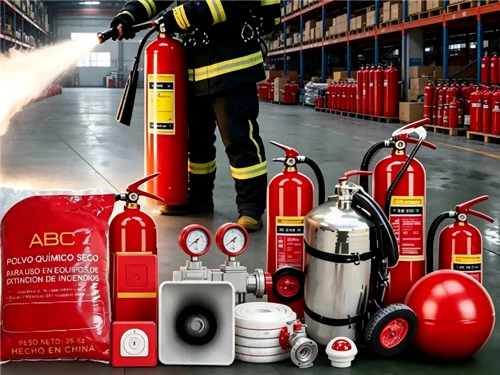
Small portable fire extinguishers of 1kg and 2kg capacity are among the highest-volume SKUs for global importers, retailers, property managers and private-label brands. They are popular for home use, apartment buildings, small shops, vehicles, RVs, boats and server cabinets. Many buyers treat these compact units as low-risk, simple commodity items and focus only on unit price. This is a common and dangerous mistake.
Although 1kg and 2kg extinguishers look compact and lightweight, they remain pressurized life-safety devices. Their smaller size brings unique design constraints: thinner cylinder walls, limited agent loading, shorter discharge time and tighter tolerance for component defects. A quality shortcut that may pass unnoticed on a 4kg or 6kg extinguisher can lead to complete discharge failure, pressure leakage or cylinder safety hazards on these mini models.
This guide is tailored for buyers planning OEM or bulk orders of 1kg and 2kg extinguishers. It lists every critical item to confirm with your supplier, including Weimin Fire Protection, before sample approval and mass production.
- 1. Confirm Valid Certification Matching the Exact 1kg / 2kg Model
- 2. Select Extinguishing Agent and Verify Fire Rating for Small-Capacity Units
- 3. Cylinder: Pressure Vessel Design for Compact Sizes
- 4. Valve, Gauge and Internal Assembly Details
- 5. Labeling Requirements for Small Extinguishers
- 6. Packaging, Marking and Dangerous Goods Rules
- 7. QC and Sampling Plan Before Shipment
- 8. Commercial and After-Sales Terms
- Final Takeaway
1. Confirm Valid Certification Matching the Exact 1kg / 2kg Model
Certification is non-negotiable, and it must cover the specific capacity you order. Many suppliers hold certificates for larger extinguishers but do not have the same approval for 1kg or 2kg variants. Standards and local compliance rules still apply, even for these small sizes.
Before placing the order, check these points:
- The certificate scope explicitly includes 1kg and/or 2kg capacity, the extinguishing agent type and the cylinder design. A certificate for a 4kg ABC extinguisher cannot automatically cover a 2kg ABC unit.
- Confirm the standard your market requires: EN 3 for EU and many emerging markets, UL standards for North America, INMETRO for Brazil, IRAM for Argentina or other local conformity documents.
- Check whether your private brand can be added to the certification. For many markets, the certificate holder must be the manufacturer, and the importer information must be correctly declared on labels and customs documents.
- Verify certificate validity and surveillance status. Expired or suspended certifications will result in cargo detention at customs, even if the product visually looks correct.
2. Select Extinguishing Agent and Verify Fire Rating for Small-Capacity Units
The fire rating of 1kg and 2kg extinguishers is limited by their low agent volume. Buyers should never overstate performance or assume the same rating as larger models. The most common agent options for small sizes are ABC dry chemical, BC dry chemical and clean agents. CO₂ versions are also available but usually carry higher cost and stricter shipping rules.
ABC Dry Chemical (Most Popular for 1kg / 2kg)
These are used for homes, small retail stores and general premises, covering Class A, B and C fires. Pay close attention to powder grade. Common grades include 40%, 75% and 90% monoammonium phosphate. Many low-cost 1kg units use low-grade powder with low active content, which will not meet the marked fire rating.
Because the total powder mass is small, anti-caking performance matters far more than it does on larger extinguishers. Even minor moisture ingress can make the limited powder inside clump completely, leaving the unit unable to discharge in an emergency. Confirm the powder has siliconized water-repellent treatment, with moisture content controlled at ≤0.25%.
BC Dry Chemical
BC powder models are mainly for fuel, gas and electrical risks, such as gas stations, generator rooms and vehicle fleets. They do not fight solid material Class A fires effectively, and this limitation must be clearly printed on labels.
Clean Agent and CO₂ Types
Clean agent and 2kg CO₂ extinguishers are chosen for IT rooms, laboratories and equipment where powder residue cannot be tolerated. Note that CO₂ units store much higher internal pressure. The cylinder design, valve and test standard differ significantly from dry powder versions.
Fire Rating Check
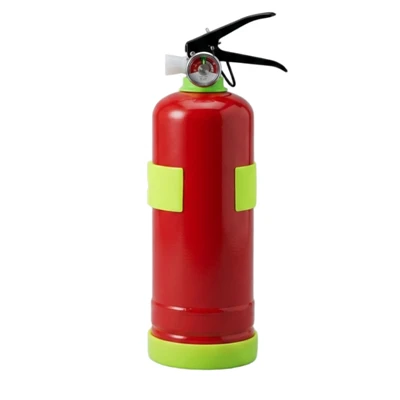
Ratings such as 1-A:5-B:C or 5-B:C must come from official fire tests conducted on the 1kg or 2kg unit itself. Buyers should reject any supplier that prints high ratings without supporting test data. End users often underestimate how quickly a fire spreads; a small extinguisher is only for early-stage small fires, and honest rating labeling protects both the importer and end users from liability.
Also confirm the operating temperature range. Many 1kg vehicle extinguishers face extreme temperature swings inside cars, so the pressure stability across hot and cold conditions must be validated.
3. Cylinder: Pressure Vessel Design for Compact Sizes
The cylinder is the highest-risk component for small extinguishers. To keep the product light and cheap, some factories reduce wall thickness beyond the safe limit. For 1kg and 2kg units, there is very little safety margin for cutting corners on steel.
Core cylinder checklist:
- Drawn seamless steel construction. Welded cylinders are not acceptable for most certified portable extinguisher standards.
- Wall thickness matched to the approved technical drawing. Do not accept thinner steel than the golden sample.
- Hydrostatic pressure test: 1.5 times maximum working pressure, held for at least 60 seconds, with no leakage, sweating or permanent deformation. Each batch must retain test records.
- Burst pressure meets standard requirements. Small cylinders with insufficient wall thickness may burst under overpressure or high ambient heat.
- Permanent stamping on the cylinder body: working pressure, test pressure, manufacturer mark, batch code and production date. Stick-on printed marks are not accepted by fire authorities in most markets.
- Internal anti-corrosion coating. This is critical for humid regions such as Southeast Asia, Latin America and coastal areas, where rust inside the cylinder can block the dip tube or weaken the vessel over time.
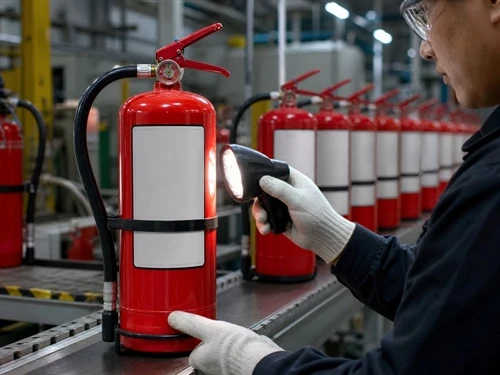
When reviewing samples, compare the weight of the empty cylinder against the approved spec. An unusually light 2kg extinguisher is often a warning sign of insufficient steel thickness.
4. Valve, Gauge and Internal Assembly Details
The valve assembly controls discharge, and failures are very common on low-end small extinguishers. Since the internal space is limited, the dip tube, seals and valve body must be precisely sized for 1kg and 2kg shells.
Always run full discharge functional tests on pre-production samples to verify that the dip tube, valve, and nozzle configuration perform reliably.
5. Labeling Requirements for Small Extinguishers
Label space on 1kg and 2kg extinguishers is limited, which creates a special challenge. All mandatory information must fit clearly, without tiny, unreadable text. This is one of the top reasons shipments get held at customs.
Mandatory label content:
- Manufacturer name (Weimin Fire Protection)
- Importer name, address and tax ID for your target country
- Capacity: clearly marked 1kg or 2kg
- Agent type and net weight of extinguishing agent
- Fire classification and official fire rating
- Illustrated operation steps
- Temperature range
- Maintenance, recharge and hydrostatic test interval
- Hazard warnings and shelf-life notes
- Local language: Spanish, Portuguese, English or other required language depending on your sales territory
Other practical checks:
- Label material must resist UV light, heat and moisture. Many small extinguishers are installed outdoors or inside vehicles where cheap stickers fade and peel quickly.
- Do not overcrowd the artwork. Too much text on a tiny label leads to non-compliance. Work with Weimin's design team early to adjust layout before printing.
- Confirm whether local regulators require the label to be waterproof or abrasion-resistant.
6. Packaging, Marking and Dangerous Goods Rules
Even 1kg and 2kg extinguishers are classified as UN 1044, Class 2.2 non-flammable compressed gas dangerous goods under IMDG, ADR and IATA rules. Many buyers mistakenly believe small size means simplified shipping, but this is not always true.
Key logistics points:
- Outer cartons must be UN-certified dangerous goods packaging if not eligible for limited quantity exemption.
- Outer packaging must show UN 1044, Class 2.2 hazard symbol, shipping marks and destination information.
- Limited quantity rules may apply for small units, which can reduce documentation complexity for sea and road transport. You must confirm this with your freight forwarder for your port of discharge.
- CO₂ 2kg extinguishers face tighter shipping restrictions than dry powder versions. Some carriers limit or refuse CO₂ extinguishers for air freight.
- Carton quantity: confirm how many pieces fit per export carton. Overpacking can damage gauges and valves during transit.
7. QC and Sampling Plan Before Shipment
Certification approves the design, but every batch of 1kg and 2kg extinguishers needs strict inspection. Due to their compact structure, defects are easier to miss. Weimin recommends this three-stage QC process for small-capacity orders:
If you supply large retail chains, vehicle brands or property groups, you may also require ISO 9001 factory audit records.
8. Commercial and After-Sales Terms
Before confirming the order with Weimin, clarify these terms specific to small-size extinguisher projects:
- MOQ for 1kg and 2kg models. These small SKUs often have different MOQs from larger extinguishers.
- Private labeling cost, mold charge and artwork ownership.
- Spare parts supply: spare valves, gauges, O-rings and tamper seals for your after-sales and recharge network.
- Warranty period. Small extinguishers usually have a stated shelf life; confirm the warranty covers manufacturing defects such as leakage.
- Lead time if you need to add a new local certification for 1kg / 2kg models. Separate testing will extend the schedule.
Final Takeaway
1kg and 2kg fire extinguishers serve high-volume consumer and light commercial markets, but they are not low-risk products. Their compact size leaves little safety margin for poor steel, low-grade powder, mismatched dip tubes or unreliable valves. Buyers who only compare unit price often receive products that leak, cake or fail to discharge when needed.
Before confirming your bulk order, verify the certification scope covers exactly 1kg or 2kg, test the powder quality, audit cylinder wall specs, check valve and gauge reliability, approve readable local-language labels and lock in a formal QC plan.
Working with Weimin Fire Protection, you can submit your target market and required standard. Our engineering team will provide compliant sample specs, test reports and label templates tailored for 1kg and 2kg extinguishers, helping you avoid customs delays and product liability risks.