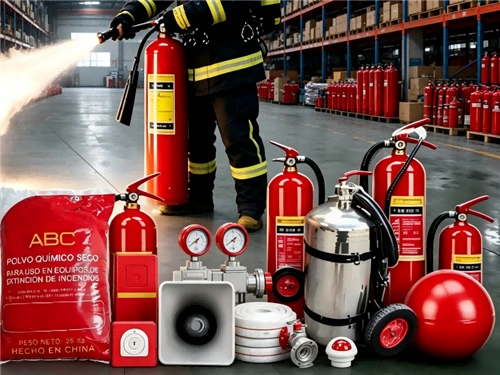
The weight of a fire extinguisher depends on its extinguishing agent capacity, cylinder material, valve assembly, hose or nozzle, pressure components and overall construction. Importantly, the number shown as 1 kg, 2 kg, 4 kg, 6 kg, 9 kg or 12 kg usually refers to the nominal charge of the extinguishing agent, not the total weight of the fully assembled extinguisher.
For buyers sourcing fire extinguishers in volume, distinguishing between agent weight, empty weight and filled weight is important for product comparison, transportation planning, installation and technical documentation.

Quick Answer: How Much Does a Fire Extinguisher Weigh?
There is no single standard weight for all fire extinguishers.
For example, an ABC dry powder extinguisher with a 6 kg nominal powder charge does not weigh only 6 kg. The complete product also includes the cylinder, valve, siphon tube, handle, hose or nozzle and other components.
A practical procurement specification should therefore distinguish between:
Nominal agent capacity: the amount of extinguishing agent inside the extinguisher
Empty weight: the weight of the complete discharged extinguisher
Filled or gross weight: the weight of the complete charged extinguisher
This distinction is also reflected in regulatory requirements in some markets. For example, INMETRO's product-marking requirements specify both the full weight and empty weight for applicable fire extinguishers.
For international purchasing, the supplier's model-specific specification sheet should always be used rather than estimating total weight from the agent capacity alone.
What Does the Weight of a Fire Extinguisher Mean?
When suppliers or buyers refer to a "6 kg fire extinguisher," the 6 kg generally describes the nominal quantity of extinguishing agent rather than the complete product.
This is particularly important when comparing quotations from different manufacturers.
For example:
6 kg ABC fire extinguisher ≠ 6 kg total product weight
The total filled weight can be higher because the extinguisher includes the cylinder and operating components.
For procurement, buyers should ask suppliers to specify:
| Weight Term | What It Means |
|---|---|
| Nominal Agent Capacity | Weight of the specified extinguishing agent |
| Empty Weight | Complete extinguisher without extinguishing agent |
| Filled Weight | Complete extinguisher after charging |
| Gross Shipping Weight | Product plus packaging, where specified |
Using these definitions prevents suppliers from quoting different weight references under the same product description.
Typical Fire Extinguisher Weight by Capacity
ABC dry powder extinguishers are commonly offered in different agent capacities for commercial, industrial and general fire protection applications.
A typical product range may include:
| Nominal Agent Capacity | Typical Product Position |
|---|---|
| 1 kg | Compact portable model |
| 2 kg | Small portable model |
| 4 kg | Medium-capacity portable model |
| 6 kg | Common commercial and industrial size |
| 9 kg | Higher-capacity portable model |
| 12 kg | Large portable model |
These figures represent nominal extinguishing-agent capacity, not a universal total product weight.
The actual filled weight varies according to cylinder construction, material thickness, valve configuration and other components. Therefore, buyers should not use a generic online weight chart as the final specification for a purchase order.
For the same reason, Weimin's ABC dry powder range should be evaluated by the specific model and configuration rather than by capacity alone.
Why Does the Same Capacity Have Different Total Weights?
Two fire extinguishers with the same nominal agent capacity can have different total weights.
The main factors include:
Cylinder Material
Carbon steel and stainless steel cylinders can have different construction requirements and finished weights.
Cylinder Thickness and Design
The cylinder must be designed for the required pressure and applicable standard. Differences in wall thickness, forming and structural design affect empty weight.
Valve Assembly
Brass or other valve configurations, pressure gauges and operating handles add to the finished product weight.
Hose, Nozzle and Siphon Tube
Different discharge configurations can change the total weight.
Extinguishing Agent
Different agents have different physical properties and charging requirements. The agent's nominal weight therefore cannot be used to calculate the complete extinguisher weight.
This is why capacity, fire rating and total weight should be treated as separate technical parameters during procurement.
Does a Heavier Fire Extinguisher Have a Higher Fire Rating?
Not necessarily.
A heavier extinguisher does not automatically provide a higher fire rating. Fire performance depends on the complete tested configuration, including the extinguishing agent, cylinder design, discharge characteristics and other product parameters.
INMETRO specifically notes that two ABC powder extinguishers containing the same amount of powder can have different extinguishing capacities depending on their design.
This is an important point for distributors and project buyers:
Do not select a fire extinguisher based on weight alone.
The purchasing specification should evaluate nominal agent capacity, fire rating, applicable standard, pressure, operating temperature and certification requirements together.
How Much Does an ABC Dry Powder Fire Extinguisher Weigh?
ABC dry powder extinguishers are widely used for applications involving Class A, B and C fire risks where the specific product is tested and rated for those fire classes.
Weimin supplies ABC dry powder extinguisher models in several capacities, including 1 kg, 2 kg, 4 kg, 6 kg, 9 kg and 12 kg configurations. The appropriate model depends on the required fire rating, installation environment and market specification.
For buyers comparing suppliers, the important question is not simply:
"How much does the 6 kg extinguisher weigh?"
A better procurement question is:
"What are the nominal agent capacity, empty weight, filled weight, fire rating and applicable certification of this specific 6 kg model?"
This gives purchasing teams a technically comparable specification instead of relying on the product's capacity label alone.
How Does Cylinder Material Affect Fire Extinguisher Weight?
Cylinder material is another important consideration when comparing different extinguisher designs.
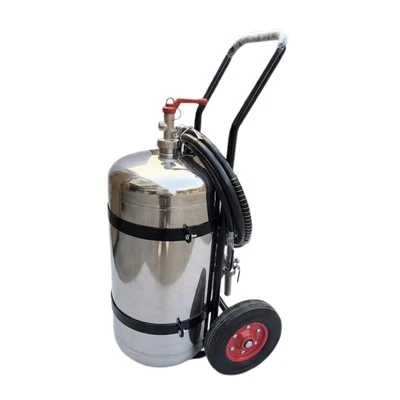
For conventional painted steel extinguishers, the cylinder normally receives a protective coating. Stainless steel extinguishers use stainless steel for the cylinder and can provide a different combination of corrosion resistance, surface appearance and material properties.
For example, SUS304 stainless steel fire extinguishers can be considered where corrosion resistance and a stainless-steel appearance are relevant to the application.
However, buyers should not assume that stainless steel automatically means either "lighter" or "heavier." Final weight depends on the complete cylinder design and specification.
This distinction is particularly relevant for:
Coastal facilities
Humid environments
Commercial buildings
Industrial facilities
Food-service environments
Equipment rooms
Projects requiring stainless steel construction
In Brazil, INMETRO states that applicable extinguisher requirements permit painted carbon-steel or stainless-steel extinguishers, while chrome-plated extinguishers are not admitted under the cited requirements.
Why Fire Extinguisher Weight Matters in Bulk Procurement
For large-volume orders, weight affects more than the product specification.
Transportation
Filled product weight contributes to pallet weight, container loading and freight calculations.
Installation
The total loaded weight affects handling and mounting considerations, particularly for larger portable models.
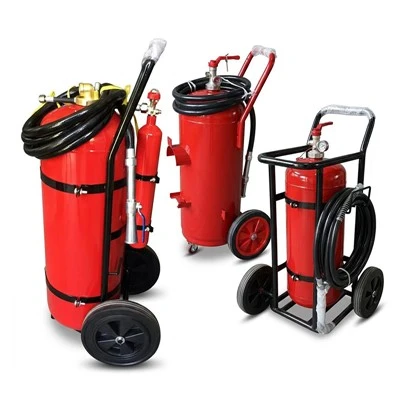
INMETRO, for example, defines portable extinguishers as those whose total loaded mass does not exceed 20 kg under the cited Brazilian standard framework; heavier extinguishers are supplied on wheeled systems.
Warehouse Handling
Distributors need accurate unit and carton weights for warehouse handling and inventory planning.
Product Comparison
A supplier quoting only "6 kg" may be referring to agent capacity rather than total product weight. Buyers should request the complete specification before comparing offers.
Shipping Documents
For export orders, accurate net and gross weights are important for packing lists, freight calculations and logistics coordination.
What Weight Information Should Buyers Confirm Before Ordering?
For a bulk fire extinguisher purchase, buyers should request a model-specific specification sheet covering:
Extinguishing agent
Nominal agent capacity
Empty weight
Filled weight
Cylinder material
Cylinder dimensions
Working pressure
Test pressure
Operating temperature
Fire rating
Applicable certification or standard
Carton and shipping weight
This information is more useful than comparing suppliers based only on a product title such as "6 kg ABC Fire Extinguisher."
For markets with specific regulatory requirements, certification and marking should also be confirmed before production. Brazil, for example, requires applicable extinguishers to undergo conformity assessment against relevant Brazilian standards, including ABNT NBR 15808 and NBR 15809 under the current INMETRO framework.
Peru also has national standards covering the selection, installation, inspection, maintenance, recharging and hydrostatic testing of portable fire extinguishers.
Fire Extinguisher Manufacturing and Quality Control at Weimin
For bulk buyers, accurate product weight is only one part of supplier evaluation. Cylinder construction, welding quality, pressure-related inspection and consistency between production batches also affect purchasing risk.
Shaoxing Weimin Fire Fighting Equipment Co., Ltd. manufactures conventional fire protection products and supports bulk supply and OEM requirements.
For its fire extinguisher production, the manufacturing process can include:
Material Preparation → Cylinder Forming → Circumferential Welding → Weld Inspection → Surface Treatment → Assembly → Pressure-Related Inspection → Finished Product Inspection
For steel extinguisher cylinders, Weimin uses automatic circumferential welding and X-ray weld inspection in its relevant manufacturing process. This provides a more objective method for checking weld integrity than relying only on visual inspection.
The company also operates an ISO 9001 quality management system and has an established export business serving customers across multiple overseas markets.
For buyers ordering large quantities, this manufacturing capability is important because the objective is not simply to receive one correctly specified sample. The supplier must maintain consistent dimensions, weight, components and production quality across the commercial batch.
FAQ
Q: Does a 6 kg fire extinguisher weigh 6 kg?
A: No. The 6 kg figure normally refers to the nominal extinguishing-agent capacity. The complete filled extinguisher weighs more because it includes the cylinder, valve and other components.
Q: What is the difference between empty weight and filled weight?
A: Empty weight is the weight of the complete discharged extinguisher, while filled weight is the weight after the specified extinguishing agent has been charged.
Q: Does a heavier extinguisher have a higher fire rating?
A: Not necessarily. Fire rating depends on the tested product configuration and fire performance rather than agent weight alone.
Q: What weight should I use for shipping calculations?
A: Use the supplier's confirmed net product weight and gross packed weight rather than the nominal agent capacity.
Q: Can Weimin provide different extinguisher capacities?
A: Yes. Weimin's ABC dry powder extinguisher range includes multiple nominal capacities, with model selection and final specifications confirmed according to the buyer's requirements.
Q: Can the extinguisher be supplied with OEM requirements?
A: Yes. Weimin supports OEM customization and bulk supply, with labels, packaging and product specifications confirmed according to the order.