Choosing between an ABC dry powder fire extinguisher and a CO₂ fire extinguisher is not simply a matter of deciding which product is better. The appropriate choice depends on the type of fire hazard, the equipment being protected, the operating environment, residue considerations, required capacity, and applicable local standards.
In general, ABC dry powder fire extinguishers offer broader protection across Class A, B and C fire risks, making them suitable for many general industrial, commercial and storage applications. CO₂ fire extinguishers are particularly useful for certain electrical equipment and applications where avoiding powder residue is an important consideration.
For distributors, importers, contractors and industrial buyers, the better approach is to select the extinguisher according to the actual risk rather than choosing a product based only on price or agent type.
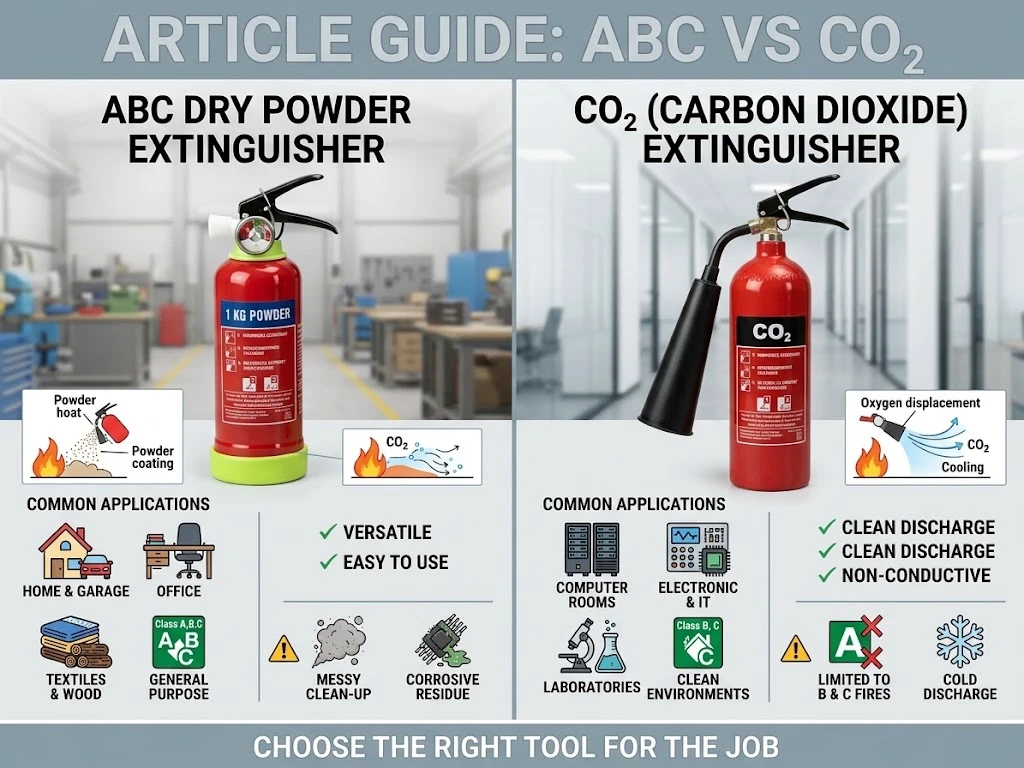
ABC vs CO₂ Fire Extinguishers: Quick Comparison
| Factor | ABC Dry Powder Fire Extinguisher | CO₂ Fire Extinguisher |
|---|---|---|
| Main agent | Dry chemical powder | Carbon dioxide |
| Typical fire classes | A, B and C, subject to product rating and applicable standard | B and C in applicable classifications |
| Ordinary combustibles | Suitable when appropriately rated | Not generally the primary choice |
| Flammable liquids | Suitable when appropriately rated | Suitable for applicable risks |
| Energized electrical equipment | Applicable products may be rated for this use | Commonly selected for electrical equipment |
| Residue | Powder residue remains after discharge | No powder residue |
| Mixed fire risks | Broad application | More specialized |
| General industrial use | Often a practical choice | Depends on the hazard |
| Sensitive equipment | Residue may require consideration | Often preferred where residue is a concern |
| Bulk procurement | Multiple capacities can be specified | Capacity and application need to be matched |
Fire extinguisher selection should always be based on the actual hazard and the requirements applicable to the installation. OSHA materials, for example, identify multipurpose dry chemical extinguishers for Class A, B and C hazards, while carbon dioxide is among the extinguisher types used for Class B and C hazards.
What Is an ABC Dry Powder Fire Extinguisher?
An ABC dry powder fire extinguisher is a multipurpose extinguisher designed for applicable Class A, Class B and Class C fire risks.
Class A hazards generally involve ordinary combustible materials such as wood, paper and cloth. Class B hazards involve flammable or combustible liquids and gases, while Class C classifications can involve energized electrical equipment where a non-conductive extinguishing medium is required.
This broad coverage is one of the main reasons ABC extinguishers are commonly considered for general industrial and commercial protection.
Why Do Buyers Choose ABC Dry Powder Extinguishers?
The main procurement advantage is application coverage.
A facility may contain several types of fire hazards rather than just one. For example, a manufacturing site could have:
- Packaging materials
- Plastic or rubber components
- Flammable liquids
- Production machinery
- Electrical equipment
- Storage areas
For such environments, a suitably rated ABC extinguisher can provide broader coverage than an extinguisher designed for a narrower application.
For distributors and wholesalers, another advantage is the availability of different capacities. A product range can include smaller units for general areas and larger units for applications requiring greater extinguishing capacity.
Weimin Fire manufactures ABC dry powder fire extinguishers in 1 kg, 2 kg, 4 kg, 6 kg, 9 kg and 12 kg configurations, allowing bulk buyers to select different capacities according to their product portfolio or project requirements.
What Is a CO₂ Fire Extinguisher?
A CO₂ fire extinguisher uses carbon dioxide as the extinguishing agent. Carbon dioxide is electrically nonconductive and works by reducing the concentration of oxygen or fuel vapor around the fire to a level at which combustion cannot continue.
CO₂ extinguishers are commonly considered for electrical equipment and certain Class B fire risks, particularly where leaving dry powder residue would create an additional maintenance concern.
Why Is Residue an Important Consideration?
The difference in discharge residue is one of the most important distinctions between ABC and CO₂ extinguishers.
An ABC extinguisher discharges dry chemical powder. After the fire is controlled, the powder needs to be cleaned from the protected area and, depending on the equipment, may create additional maintenance work.
CO₂ does not discharge dry powder.
This makes CO₂ an option worth considering for areas such as:
- Electrical control equipment
- Control panels
- Certain machinery areas
- Sensitive electrical equipment
- Locations where powder contamination is undesirable
However, buyers should not assume that CO₂ is automatically the correct choice for every electrical fire. The specific equipment, fire risk, extinguisher rating, installation requirements and applicable standards should all be evaluated before procurement.
ABC vs CO₂ Fire Extinguishers by Application
The most useful way to compare these two extinguisher types is to look at the actual application.
Manufacturing Facilities
Manufacturing plants often contain multiple fire hazards.
Raw materials, packaging, machinery, electrical systems and flammable substances may exist within the same facility.
For general areas with mixed fire risks, an appropriately rated ABC dry powder extinguisher can be a practical option because of its broader fire-class coverage.
CO₂ extinguishers may be considered for specific electrical equipment areas where minimizing powder residue is important.
For large manufacturing projects, the answer may therefore be a combination of extinguisher types rather than choosing only one.
Warehouses
Warehouses commonly contain:
- Cartons
- Paper products
- Packaging materials
- Plastics
- Textiles
- Wood products
- Stored goods
These materials can create Class A fire risks, while some warehouses may also store liquids or other materials that introduce additional hazards.
For general warehouse protection, appropriately rated ABC extinguishers are often considered because they can cover multiple fire classes.
However, storage conditions and the actual materials being stored should determine the final selection.
Electrical Rooms and Control Panels
Electrical equipment requires particular attention because the extinguishing agent must be suitable for energized equipment when power cannot immediately be isolated.
CO₂ is commonly selected for certain electrical equipment because it is electrically nonconductive and does not leave dry powder residue. OSHA guidance also identifies carbon dioxide among extinguisher types used for Class C hazards.
For buyers sourcing extinguishers for electrical rooms, the key question should therefore be:
Is the extinguisher appropriately rated and approved for the specific electrical application and applicable requirements?
Workshops and Industrial Production Areas
Workshops can contain a mixture of:
- Combustible materials
- Oils
- Solvents
- Machinery
- Electrical equipment
- Packaging materials
ABC dry powder extinguishers may provide broad coverage for many general workshop hazards.
Where electrical equipment presents a specific risk and powder residue is undesirable, CO₂ may be considered as a supplementary option.
Commercial Buildings
Commercial buildings often contain different risk zones rather than one uniform fire hazard.
For example:
- Offices may contain paper, furniture and electrical equipment.
- Equipment rooms may contain electrical systems.
- Storage rooms may contain packaging materials.
- Kitchens may involve cooking-oil hazards requiring a different extinguisher classification.
Therefore, purchasing the same extinguisher for every location may not always be appropriate.
The correct approach is to identify the hazard in each area and then select the appropriate extinguisher type and rating.
When Should Buyers Choose ABC Instead of CO₂?
ABC dry powder extinguishers are generally worth considering when the buyer needs broader coverage across multiple fire risks.
They may be suitable for:
General industrial areas
Where ordinary combustibles and other applicable hazards are present.
Warehouses
Especially where paper, cardboard, wood, textiles or other ordinary combustibles are stored.
Workshops
Where several types of fire hazards can occur in the same operating area.
Mixed-risk facilities
Where buyers want an extinguisher type capable of addressing several applicable fire classes.
Distributor product portfolios
Distributors may prefer a range of ABC extinguishers because different capacities can serve different end-user applications.
For bulk procurement, the availability of multiple capacities can also simplify product assortment planning.
When Should Buyers Consider CO₂ Instead?
CO₂ may be more appropriate when the application has a specific need for a clean discharge without dry powder residue.
Typical considerations include:
Electrical equipment
CO₂ is commonly considered for certain energized electrical equipment.
Control panels
Where powder contamination may create additional cleaning requirements.
Sensitive equipment areas
Where avoiding dry chemical residue is an important procurement consideration.
Equipment rooms
Where the fire risk and applicable requirements support the use of CO₂ extinguishers.
However, CO₂ also has limitations. OSHA guidance notes that carbon dioxide extinguishers can create oxygen-deficiency concerns in confined areas and can be less effective in windy conditions.
This is why application suitability should come before product preference.
ABC vs CO₂: Which Is Better for Industrial Applications?
There is no universal winner.
For many general industrial applications, an appropriately rated ABC dry powder extinguisher can be a strong choice because it provides broader coverage across applicable fire classes.
For certain electrical equipment applications, CO₂ may be preferred because it is electrically nonconductive and does not leave dry powder residue.
The decision can be summarized as follows:
- Choose ABC when broader fire-class coverage is the primary requirement.
- Consider CO₂ when electrical equipment and residue considerations are more important.
- Consider using both when a facility contains substantially different fire hazards in different areas.
This risk-based approach is more appropriate than selecting an extinguisher simply because it is cheaper or more popular.
Should Buyers Use ABC and CO₂ Extinguishers Together?
For larger facilities, using different extinguisher types in different areas may be more appropriate than relying on one type throughout the entire site.
For example:
| Facility Area | Potential Choice | Main Consideration |
|---|---|---|
| General production area | ABC | Broad applicable fire-class coverage |
| Warehouse | ABC | Ordinary combustible materials |
| Electrical control room | CO₂ | Electrical equipment and residue |
| Machinery area | ABC / CO₂ | Depends on the specific hazard |
| Sensitive equipment area | CO₂ may be considered | Minimal powder residue |
| Mixed-risk facility | Combination | Different areas may have different hazards |
This is particularly relevant for contractors and project buyers responsible for supplying complete fire protection equipment packages.
The final configuration should be based on the fire risk assessment, product ratings, local requirements and applicable standards.
What Should Buyers Check Before Ordering Fire Extinguishers in Bulk?
Selecting the agent is only the first procurement decision.
Before placing a bulk order, buyers should confirm the following:
Fire classification
Confirm which fire classes the product is designed and rated for.
Capacity
Different applications may require different extinguisher capacities.
Product configuration
Check cylinder dimensions, valve configuration, operating pressure and other applicable specifications.
Applicable standards and certification
Requirements vary between countries and markets. Buyers should confirm which certifications, approvals, markings and testing documentation are required for their destination market.
Packaging
For export orders, packaging should be discussed according to the transportation method, order quantity and distributor requirements.
OEM and private-label requirements
Distributors and brands may need customized labels, packaging or product configurations.
Quality control
For bulk orders, buyers should understand how the manufacturer controls cylinder processing, welding, surface treatment, assembly and inspection.
Production capacity and lead time
A supplier should be able to confirm whether the required quantity and product mix can be produced within the requested schedule.
What Should Buyers Look for in an ABC Fire Extinguisher Manufacturer?
For distributors, importers and industrial project buyers, the manufacturer matters as much as the product specification.
A suitable supplier should be able to support more than one standard product configuration.
Key questions include:
- Can the manufacturer supply multiple capacities?
- Can the manufacturer support OEM orders?
- Can labels and packaging be customized?
- Can the supplier handle bulk quantities?
- How are cylinders processed and finished?
- How is welding quality controlled?
- What inspections are performed before shipment?
- Can the manufacturer provide the required export documentation?
- Can the supplier support different product configurations for different markets?
These questions help buyers distinguish a manufacturer capable of handling project or distribution orders from a supplier focused only on spot sales.
How Weimin Fire Supports Bulk Fire Extinguisher Procurement
Weimin Fire focuses on conventional fire protection equipment for bulk buyers, distributors, importers, contractors and project procurement.
For ABC dry powder extinguishers, Weimin Fire offers a range of capacities from 1 kg to 12 kg, allowing buyers to build different product combinations according to application and market requirements.
The company also supports OEM production and bulk orders, making it possible to discuss product configuration, labeling, packaging and other procurement requirements before production.
Manufacturing and quality-control processes include cylinder surface preparation, phosphating, electrostatic powder coating and curing. For applicable welding processes and product requirements, welding inspection can include X-ray inspection where required.
This is important for B2B buyers because product selection is only one part of the procurement decision. Consistent production, inspection procedures, packaging and export coordination can also affect the success of a large order.
ABC vs CO₂ Fire Extinguishers: Final Buying Guide
So, which is better: ABC or CO₂?
ABC dry powder fire extinguishers are generally more versatile for applications involving applicable Class A, B and C fire risks. They are particularly relevant to general industrial areas, warehouses, workshops and other mixed-risk environments.
CO₂ fire extinguishers are more specialized and are commonly considered for certain electrical equipment and applications where avoiding dry powder residue is important.
For large facilities, the best approach may be to use different extinguisher types for different risk areas rather than selecting one product for the entire facility.
Before placing a bulk order, buyers should evaluate:
- Fire classes and hazards
- Application environment
- Electrical equipment requirements
- Residue considerations
- Required capacity
- Applicable standards and certifications
- Product configuration
- OEM and packaging requirements
- Factory quality control
- Production capacity and delivery schedule
The right extinguisher is therefore not simply the one with the broadest application or lowest price. It is the product that matches the actual fire risk and procurement requirements of the intended application.
Need ABC Fire Extinguishers for Bulk Procurement?
If you are sourcing ABC dry powder fire extinguishers for distribution, industrial facilities, construction projects or other bulk applications, Weimin Fire can discuss the required capacity, configuration, packaging and OEM requirements based on your project.
Send Your Bulk Order Requirements